
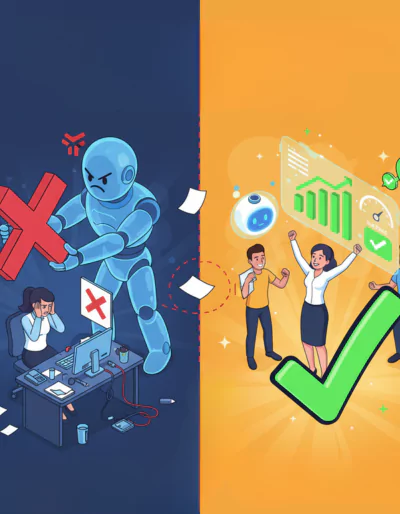
N3 Automation Myths Debunked: Why AI Isn’t Here to Replace You (But to Help You Win)
I. Introduction: Fear vs. Reality in the Age of AI
[rank_math_toc]
Open a news app and it can feel like the end is nigh: headlines warn that robots are coming for everyone’s job, B-roll shows chrome androids clacking away at keyboards, and comment sections spiral into “humans vs. machines” doom. No wonder so many owners of small and mid-sized businesses tense up when they hear the word “automation.”
Here’s the fuller picture: AI isn’t a single, unstoppable replacement machine. It’s a toolbox. Used well, it strips out drudgery—data entry, scheduling, repetitive replies—so people can double down on the work only people do well: creative thinking, judgment, empathy, negotiation, and relationship-building. That’s not sci-fi; it’s operations. And for smaller organizations that run lean, the upside is especially compelling: fewer dropped balls, faster response times, and more owner time unlocked for strategy.
A useful way to cut through the noise is to look at tasks, not jobs. Decades of research show that while parts of most roles can be automated, very few roles are fully automatable. McKinsey’s foundational analysis put numbers to that reality: less than 5% of occupations are 100% automatable, but about 60% of jobs include at least one-third of activities that could be automated. Translation: work is being reshaped, not erased. (McKinsey & Company)
Global labor bodies echo the same pattern. The OECD estimates roughly 14% of jobs are at high risk of automation, with another 32% likely to undergo substantial change as tasks are reallocated between humans and software. Again, that implies evolution—redesigning how work gets done—rather than wholesale elimination of roles. (OECD)
What does that look like on the ground for a local services firm, a medical practice, a boutique agency, or a growing e-commerce brand? Think: every inbound call or chat gets answered on the first ring by a voice/chat agent, appointments book themselves, follow-ups never slip, routine FAQs are handled instantly, and content queues publish on schedule in your brand voice. The human moments don’t disappear—they get prioritized. Your team spends its energy where it matters: resolving edge cases, winning deals, and building loyalty.
Even the most current employer surveys anticipate more task automation rather than full role replacement. The World Economic Forum’s 2023 outlook, for example, projects that around 42% of business tasks could be automated by 2027—heavy in data processing and routine workflow—while reasoning, collaboration, and creative work remain distinctly human. That division of labor is the opportunity: let software carry the load it’s great at so people can do the work only they can do. (World Economic Forum)
At One Big Media Company (OBMC), we see this every week with clients who arrive worried automation will make them feel less authentic. The opposite happens. Removing the “busywork tax” actually restores the human touch: owners show up more on calls, teams respond faster with better context, and marketing sounds more like them because they finally have time to guide the message. Automation isn’t about replacing your personality; it’s about removing the friction that keeps it from showing up consistently.
This series will unpack the stickiest myths—job loss, “robotic” customer experiences, cost, and complexity—and replace them with practical, verifiable realities. If you keep one idea in mind as you read, make it this: AI is not here to replace you. It’s here to help you win.
👉 See how OBMC helps small businesses deploy AI that feels human: onebigmediacompany.com.
II. Myth #1: “AI Will Take All Our Jobs”
If there’s one automation myth that never seems to die, it’s this one: “AI is coming to take every job.” The fear makes sense at first glance—after all, history is full of moments where technology displaced specific types of work. The printing press ended the era of manual scribes. Industrial looms put weavers out of business. More recently, self-checkout stations reduced cashier positions in retail. These examples make it tempting to assume AI will do the same, only faster and across every industry.
But the real story is far more nuanced. Research shows that while AI will change how most jobs are performed, very few will be eliminated entirely. Instead, automation redistributes tasks, moving repetitive and low-value work to machines while freeing people to focus on creative, strategic, and relational responsibilities. This shift doesn’t shrink the economy—it reshapes it.
Consider data from the World Economic Forum’s Future of Jobs Report (2023). The WEF projects that by 2027, automation and AI will significantly transform about 44% of current workers’ skills. But alongside these shifts, they forecast a net job creation effect, with new roles in technology development, sustainability, and human-AI oversight outpacing losses. In fact, they estimate 69 million new jobs will be created globally in the coming years, particularly in areas that emphasize problem-solving and creativity.
Other analysts back this up. Gartner predicts that by 2030, AI will generate more jobs than it eliminates, with many falling into categories that didn’t exist a decade ago: AI trainers, automation strategists, customer experience specialists, and digital ethicists. The point is clear: work doesn’t vanish—it evolves.
Let’s break this down for a small business owner. Imagine you’re running a dental office. A receptionist spends much of their day answering calls, confirming appointments, and rescheduling no-shows. A Voice AI Agent can now handle those tasks, 24/7. On the surface, it looks like that role disappears. But in practice, it means your front desk staff can pivot to higher-value activities—like greeting patients in person, managing care follow-ups, or helping with patient experience initiatives. The “job” remains, but its focus changes to areas where human empathy and judgment matter most.
History gives us useful parallels. When ATMs rolled out in the 1970s, experts predicted the decline of bank tellers. Yet what happened was the opposite: automation of routine transactions allowed banks to open more branches, and teller jobs actually expanded for decades. Their roles shifted toward customer service and financial advisory work. AI will likely drive similar role evolution rather than wholesale elimination.
It’s also worth remembering that AI has limits. Machines excel at structured, repetitive, data-driven tasks. But customers still value empathy, nuanced problem-solving, and genuine connection—areas where humans remain irreplaceable. AI can schedule a consultation, but it cannot nurture long-term trust or offer innovative solutions in a face-to-face conversation.
For small and mid-sized businesses, this distinction is especially critical. Unlike large corporations with specialized departments, smaller companies often operate with lean teams. Owners wear multiple hats, and time is one of the scarcest resources. Offloading repetitive work to AI doesn’t eliminate the need for people; it creates breathing room for them to do the high-impact, high-value work that drives growth.
The real risk isn’t AI itself—it’s letting fear of AI stop you from adapting. If a competitor embraces automation while you avoid it, they’ll respond faster, operate leaner, and scale smarter. The danger isn’t machines replacing humans; it’s humans refusing to evolve.
At OBMC, we’ve seen firsthand how reframing this mindset transforms businesses. When owners stop worrying about “replacement” and start seeing AI as a partner, they unlock new levels of growth. AI doesn’t take their jobs away—it gives them back the freedom to focus on the meaningful parts of their work.
👉 Learn how OBMC helps businesses elevate human roles with automation: onebigmediacompany.com.
III. Myth #2: “Automation Makes Businesses Feel Robotic”
It’s common to hear small business owners say: “If I let AI take over parts of my workflow, I’ll lose the personal touch. My customers will feel like they’re talking to machines, not people.” That’s a fair concern—but today’s automation is much more sophisticated, and when done right, it enhances rather than erodes authenticity.
Personalization at Scale
One of the strongest counters to the “robotic brand fear” is how automating with personalization lets businesses engage each customer in meaningful ways. McKinsey’s recent research shows customers increasingly expect tailored experiences—not generic messaging. (McKinsey & Company)
Platforms now allow businesses to use real-time behavior, preferences, past purchases, and browsing patterns to adapt content, offers, and communications. For example, dynamic emails might show products someone actually browsed; website homepages might shift based on what a returning customer has done before. This kind of personalization means that even though automation is involved, the interaction feels relevant and “just for me.”
Customers Expect Speed and Responsiveness
Another major factor: speed. One of the biggest frustrations for customers is delay—waiting for replies, slow resolution, repeated follow-ups. Automation helps eliminate lag.
- A HubSpot study found that 90% of customers say an immediate response is essential when they have a customer service question. (Help Scout)
- Moreover, email response expectations are shifting sharply. In 2025, 88% of customers expect a reply within 60 minutes of emailing a business, and many define “immediate” as 10 minutes or less. (Superhuman Blog)
When businesses use automation—chatbots, AI agents, auto-responses—those first touchpoints often get handled quickly. The customer feels heard, even before a human steps in. That can preserve trust and reduce frustration.
Consistency Builds Trust
Humans are wonderful—but inconsistent. Some days you might reply fast; others not. Automation helps maintain standards: scheduling, follow-ups, posting content, keeping promises. When customers see consistency—social posts always there, replies coming at all hours, expect no dead time—it sends the message: “This business runs reliably. I can depend on it.”
That reliability often feels more human than the occasional burst of attention followed by silence.
The Right Balance: Automation + Human Touch
Automation doesn’t have to do everything. It shines when it handles repetitive, predictable parts of work—answering common FAQs, routing leads, confirming appointments. Humans still handle what machines aren’t good at: empathy, handling complex or unusual situations, surprises, and creative strategy.
So design your system so that there are seamless hand-offs. For example:
- A voice or chat-bot answers common questions instantly, but escalates to a human when the question is complicated or emotional.
- Content is drafted using AI cloning or templates, but reviewed, refined, and given personal flourishes by a human.
- Follow-ups are automated, but with options for personal notes or customizations from real people.
Evidence: What Customers Actually Want
Here are a few hard data points:
- 71% of consumers expect personalized experiences; when they don’t get them, they feel frustrated. (SuperOffice)
- 90% of people say fast/immediate response is important when they reach out with a question. (SuperOffice)
- 73% of consumers will switch to a competitor after multiple bad experiences. Consistency—and ensuring good experience every time—is part of what holds customers. (Zendesk)
Putting It Into Practice (OBMC-Style)
At OBMC, our automation tools are built to preserve your voice and values. Here’s how:
- We use Hyper-Realistic AI Clones that learn your tone, style, and voice so content matches how you talk—whether it’s social posts or email newsletters.
- Voice AI Agents answer calls around the clock, but when issues are complex, they escalate to you or your team, so customers always have access to human judgment and empathy.
- Automation is set up behind the scenes to manage things like scheduling, confirmations, and follow-ups, so those tasks don’t slip—but customers don’t feel like every message is from a bot.
- Regular reviews ensure the messages, tone, and user experience stay aligned with what your customers expect—and with your brand’s personality.
Bottom Line
The myth that automation makes things feel robotic holds some truth if systems are poorly designed or under-supervised. But the advanced reality is quite different. When you combine speed, consistency, and data-driven personalization with the irreplaceable human qualities of empathy, creativity, and nuance, you get something not cold or distant—but responsive, authentic, and deeply human. Automation can amplify what makes your business unique, rather than drown it out.
IV. Myth #3: “Only Big Companies Can Afford AI”
One of the most persistent myths about automation is that it’s reserved for tech giants with billion-dollar budgets. Many small and mid-sized business owners picture Google, Amazon, or Apple when they hear “AI” and assume the tools are out of reach. Twenty years ago, that perception was fair—enterprise software licenses were prohibitively expensive, custom integrations required big IT teams, and AI research was confined to universities and Fortune 500 labs. But in 2025, the affordability landscape looks completely different.
Automation Costs vs. Payroll Costs
Let’s start with a simple math exercise. Hiring people is the largest expense for most businesses. A full-time receptionist in the U.S. earns between $35,000 and $45,000 per year on average, not including benefits, training, and the risk of turnover (U.S. Bureau of Labor Statistics). Marketing assistants, administrative staff, and customer service reps all add to payroll.
Now compare that with automation. A Voice AI Agent can answer calls 24/7, book appointments, and respond instantly—for a fraction of the cost of a salary. It never calls in sick, doesn’t require health insurance, and doesn’t need onboarding. For small businesses where every dollar counts, the cost comparison is striking: automation becomes the cheaper option, not the luxury.
Scaling Without Ballooning Overhead
One reason small businesses often struggle to scale is the proportional costs of growth. Double your clients, and suddenly you need more staff, more office space, more resources. It feels like growth eats itself. Automation changes that equation.
For example, an AI-driven content scheduling system doesn’t care if you’re posting for 50 customers or 5,000—it scales effortlessly. SEO optimization tools keep running in the background, regardless of your size. Automated invoicing and email follow-ups don’t ask for overtime. That means revenue can grow without costs spiraling out of control.
Democratization of AI
The biggest shift in the last decade has been accessibility. Tools once reserved for massive companies are now available to anyone with a laptop. Cloud platforms and SaaS pricing models mean you don’t need to install servers or hire IT teams.
Even big players like Microsoft and Google are explicitly designing AI platforms for small business users. Microsoft, for example, has integrated AI copilots into Office 365, letting small teams get enterprise-level productivity without extra infrastructure (Microsoft Copilot). Similarly, tools like ChatGPT and other generative AI platforms offer subscription models that cost less than a cup of coffee a day, putting advanced automation in the hands of solo entrepreneurs and local shops.
The takeaway: enterprise-level power no longer requires enterprise-level budgets.
Opportunity Cost of Avoidance
Here’s the hidden cost: avoiding automation is often more expensive than adopting it. Consider missed calls. Studies show that 85% of callers won’t call back if they don’t get through the first time. Each missed call could mean hundreds or thousands in lost revenue. Even a handful per month adds up quickly.
The same applies to marketing. Inconsistent social media posting or neglected SEO leaves revenue on the table. The cost of “doing nothing” compounds quietly but steadily, while competitors who automate get ahead.
OBMC’s Affordable Approach
At One Big Media Company (OBMC), we build automation ecosystems specifically designed for smaller businesses. Our solutions are modular—you only pay for what you need, when you need it. That means whether you’re a solopreneur looking for a single AI agent or a 20-person company needing a full automation stack, the tools are sized to your reality, not someone else’s.
We’ve seen startups on shoestring budgets use AI to look as polished as established companies. We’ve also watched local service providers (plumbers, law firms, realtors) gain back hundreds of hours per year because automation handled the scheduling and customer touch points.
The Bottom Line
The myth that “only big companies can afford AI” lingers because it was true once. But today, automation is not only affordable—it’s often cheaper than the alternatives. Cloud platforms, SaaS pricing, and democratized AI tools mean small and mid-sized businesses can access the same technology as giants, without needing deep pockets.
The real financial question isn’t “Can I afford automation?” It’s “Can I afford to keep losing revenue, time, and customers by not automating?” For most small businesses, the honest answer is no.
👉 Discover how OBMC makes automation cost-effective at onebigmediacompany.com.
V. Myth #4: “AI is Too Complicated to Use”
For many business owners, one of the biggest roadblocks to adopting automation isn’t cost—it’s fear of complexity. The myth goes like this: AI is only for tech-savvy engineers, it requires endless coding, and unless you’ve got an IT department on call, you’ll never be able to set it up or keep it running. For small and mid-sized businesses already stretched thin, the thought of adding “learn complicated software” to the to-do list is enough to hit pause.
But here’s the truth: modern AI tools aren’t built for engineers anymore. They’re built for everyday business owners, marketers, and customer service teams. Today’s platforms are designed to be intuitive, user-friendly, and plug-and-play. What once required months of custom development now works out of the box with interfaces that look and feel as familiar as email or social media.
The Shift Toward User-Friendly AI
Tech companies have invested heavily in simplifying AI. A recent report from Salesforce highlights how “low-code” and “no-code” tools are removing barriers for smaller organizations, allowing them to deploy automation with simple drag-and-drop features rather than technical expertise.
Even enterprise players like Microsoft and Google are prioritizing ease of use. Microsoft’s Copilot is embedded directly into everyday apps like Word, Outlook, and Excel, so users don’t need to learn a new system—they simply interact with AI in the tools they already use daily (Microsoft Copilot).
The message is clear: AI adoption is moving away from complexity and toward accessibility.
Integration With Existing Tools
Another reason business owners assume AI is complicated is the belief that they’ll have to replace everything they already use. In reality, most modern automation systems are built to integrate seamlessly with popular apps. Whether it’s your calendar, your CRM, or your email platform, AI connects through APIs and cloud-based integrations.
That means you don’t have to reinvent the wheel. For example, an AI-powered scheduling tool can pull directly from your existing Google Calendar, or a customer service bot can plug into your Shopify or WordPress site. Instead of creating more tech headaches, automation simplifies what’s already in place.
Learning Curve vs. Time Saved
Yes, there’s always a short learning curve when adopting new technology—but the payoff dwarfs the upfront effort. McKinsey estimates that companies adopting AI in customer operations see productivity boosts of up to 40% in routine workflows, freeing up time for higher-value activities (McKinsey).
Think of it this way: you didn’t need to understand the internal mechanics of your car to learn to drive it. You just needed to know the basics—steering, braking, accelerating. AI tools work the same way. You don’t need to know how the algorithms work; you just need to know where to click to get the results.
Ongoing Support and Simplicity
At One Big Media Company (OBMC), we’ve seen firsthand that the most effective automation isn’t just about the tools—it’s about the support behind them. That’s why we provide onboarding, walkthroughs, and ongoing guidance. The goal isn’t to turn you into a software engineer; it’s to let you get back to running your business while the technology handles the heavy lifting.
Modern automation platforms are designed with this philosophy in mind. Features like guided setup, built-in tutorials, and responsive support teams mean you’re never left on your own. And because AI learns and adapts over time, the system actually gets easier to use the longer you run it.
Freeing You From the Real Complexity
Ironically, the biggest source of complexity in many businesses isn’t AI at all—it’s manual work. Juggling spreadsheets, remembering follow-ups, manually drafting social posts, or digging through emails to find customer info is far more complicated and error-prone than a single AI-powered system running in the background. By centralizing these workflows, automation removes complexity rather than adding it.
The Bottom Line
The belief that AI is “too complicated” is rooted in the early days of clunky enterprise software. But those days are gone. Today’s AI is designed to be accessible, easy to integrate, and simple to use—even for non-technical teams. With OBMC’s tailored onboarding and support, you don’t need an IT background to scale smarter.
The truth is the opposite of the myth: automation exists to simplify your business, not complicate it.
👉 Explore how OBMC makes AI adoption painless at onebigmediacompany.com.
VI. The Truth: AI + Humans = The Winning Formula
After unpacking the big myths—job loss, robotic customer service, high costs, and complexity—what’s left is the reality: the real power of automation isn’t AI replacing humans. It’s AI and humans working together. When these two forces collaborate, businesses unlock efficiency, creativity, and growth in ways that neither could achieve alone.
What AI Does Best
AI thrives on the structured, repetitive, and data-heavy tasks that bog down human teams. Machines don’t get tired, don’t forget to follow up, and don’t lose track of details. A Voice AI Agent can answer every inbound call—even at 3 a.m.—with perfect consistency. An AI-powered SEO system continuously monitors search trends and adjusts your website without missing a beat. A content scheduler can publish across multiple platforms at the exact right times, day after day, without delay.
These functions are where human attention usually gets drained. By automating them, AI removes bottlenecks, keeps processes reliable, and ensures customers don’t slip through the cracks.
What Humans Do Best
But machines have limits. They can’t empathize. They don’t innovate on their own. They don’t build trust or creative campaigns that resonate emotionally. Customers want more than transactions; they want relationships. They want to feel valued, understood, and connected.
This is where humans shine: empathy, intuition, creativity, and problem-solving. A chatbot can book a consultation, but it takes a human to deliver expertise in that meeting. Automation can generate a draft blog post in your tone, but it’s the human strategy that decides which story to tell and how it supports your business goals.
The Symphony Analogy
The relationship between AI and humans works like a symphony, not a solo. Each instrument plays to its strengths: AI manages the tempo of repetitive logistics, while humans deliver the melody of strategy, empathy, and innovation. Together, the harmony is stronger than either could achieve alone.
For example, at OBMC, our Hyper-Realistic AI Clones produce content in a client’s authentic voice. But the direction—what campaigns to run, what tone to emphasize, what message matters most—comes from the human side. The result is consistency plus creativity: the business stays visible without losing its personality.
Scaling Without Losing Humanity
One of the biggest fears small businesses have is that scaling will erode their personal touch. Without automation, this is often true—growth means more calls missed, more delays, more inconsistencies. Ironically, automation helps preserve humanity at scale.
Take a small law office. Without automation, attorneys spend hours scheduling, sending reminders, and processing intake forms. With automation, those tasks run in the background, freeing attorneys to focus on client conversations, cases, and strategy. Instead of losing personal connection, automation gives them more time for it.
Data That Proves It Works
Executives who’ve embraced this balance report major gains. According to Harvard Business Review, 90% of leaders say AI adoption has improved efficiency, while 85% say it enhances collaboration across teams. These aren’t stats about machines replacing people—they’re proof that AI makes people better at their jobs.
And the World Economic Forum’s most recent outlook underscores the same theme: while automation will transform work, it will elevate human roles by removing drudgery and spotlighting skills like creativity, problem-solving, and empathy—skills businesses depend on most in competitive markets (WEF Future of Jobs Report 2023).
OBMC’s Human-Centered Approach
At OBMC, this partnership philosophy is baked into every solution. We don’t design systems to replace people. We design them to handle the background tasks so people can show up where they matter most. A Voice AI Agent keeps leads warm while your sales team closes deals. An AI Clone keeps your brand present online while you focus on customer relationships. Automation amplifies humanity; it doesn’t erase it.
The Bottom Line
The real winning formula isn’t AI versus humans—it’s AI plus humans. Machines do the heavy lifting with consistency and speed. People deliver empathy, creativity, and strategy. Businesses that embrace this mindset aren’t just keeping pace—they’re outpacing competitors who still see AI as a threat rather than a partner.
The future won’t belong to businesses that avoid automation, nor to those that lean entirely on machines. It will belong to those that build true human-AI partnerships.
👉 Build your winning formula with OBMC at onebigmediacompany.com.